Posted on May 12, 2026 by Rev. Jonathan Conner
Godly Living
Share
Other Blog Topics
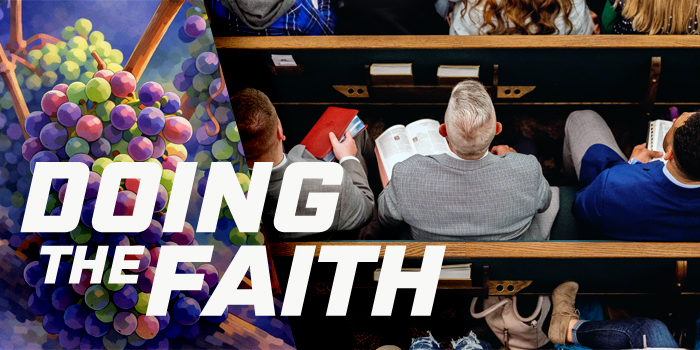
Christianity is something you do. Perhaps we should understand the word Christianity as a verb. Yes, at its heart is a Gospel we believe, a salvation that comes by grace alone, through faith alone, on account of Christ alone, but that faith is never alone. The Lutheran Confessions famously assert, “It is impossible to separate works from faith, quite as impossible as to separate heat and light from fire.”[1] We might capture this truth this way: Salvation is Christ’s work, which we receive by faith. Christianity is our work, which we do in word and deed.
Consider the way Scripture speaks. Jesus, in the Great Commission, instructs His disciples to make more disciples by baptizing and teaching people to observe His word. This is an action verb. Jesus is instructing His future followers to keep, practice, and do His word. The Apostle Paul repeatedly writes about doing the faith. He uses the image of walking, exhorting Christ-followers to walk in a manner worthy of the calling to which you have been called (Ephesians 4:1), to walk as children of light (Ephesians 5:8), to walk in [Christ], (Colossians 2:6), to walk by the Spirit (Galatians 5:16), and to walk in newness of life (Romans 6:4). John also exhorts Christ-followers to walk in the light (1 John 1:7). And James explicitly says, be doers of the word (James 1:22).
Scripture unambiguously teaches that the faith is something we do. Further, wisdom shows us that our doing of the faith reinforces the faith. Our doing strengthens and shapes our believing. The church has historically captured this idea in the Latin phrase lex orandi, lex credendi, which means “the law of praying is the law of believing.” In other words, the way the church prays (or worships) reveals and shapes what the church believes. Pause to appreciate what is being said. The words and actions that the church repeats not only reveal what we believe, but they actually shape what we believe. Our words and actions shape our faith.
For example, the Apostles’ Creed doesn’t just encapsulate the essence of the Christian faith; it shapes the very form of our faith, the way we conceptualize it and the way we express it. It teaches us to see God as Father, Son, and Spirit and to praise Him for His work of creation, redemption, and sanctification. The Creed shapes us. Churches that have rejected the historic creeds of the church often repeat the errors and heresies the creeds countered and condemned.
Making the sign of the cross recalls our Baptisms, our hope in our bodily resurrection, and our willingness to suffer for the Name of Christ. It traces these truths over our bodies and strengthens our Christian confession. Standing for the Gospel reading reinforces our holy regard for the words of Jesus. They’re important enough to stand for. Our words and actions shape our faith.
This is why the church has so carefully structured its liturgy and worship. What we do, sing, and say shapes us and the faith we confess and practice. What we repeat changes and shapes us.
Let me give you an example from everyday life. A few days ago, I was visiting with an adult parishioner. She was explaining something to me, and she used an idiosyncratic expression multiple times — one of those verbal add-ons that many of us use mostly without realizing it. Here’s what was fascinating to me: a few days later, I was visiting with her father, and guess what he did? He used the same idiosyncratic expression multiple times as he was explaining something to me! His daughter had heard her father say that expression thousands of times, and she had unknowingly incorporated it into her communication patterns. The regular and repeated action had shaped her.
This is true across the board, in nearly every area of our lives. The things we do over and over, or see done over and over, shape us. They reinforce our beliefs. They make us into the people we are. Because this is true, we need to give special attention to our doing, especially when it comes to doing the faith. The actions of the faith are essential not only to practicing the faith, but also to reinforcing it, to strengthening its habits, even to reinforcing belief itself.
For the next several installments in this series, we are going to focus on the actions of the faith. All of us should prepare to be challenged. All of us should be ready to make changes (that will change us), because our regular and repeated actions shape us in profound ways. We may have actions or habits we need to stop. We may have actions or habits we need to start and strengthen.
In this article, we are going to highlight the beating-heart center of the Christian faith: corporate worship. In coming articles, we’ll consider individual and family Bible reading, prayer, and the devotional and liturgical actions of our bodies — and how these regular and repeated actions are not only the way we do the faith, but also the way we strengthen and reinforce the faith we do.
Americans steeped in the ideals of radical individualism have largely gutted worship of its corporate nature.[2] They have reduced the we that Scripture assumes in worship to me, to “Jesus and me,” a very small and unbiblical understanding of worship.
I have had numerous conversations with individuals who hold to this understanding of worship. I ask how, without corporate worship, they are doing the faith, and the answer is consistently disappointing. They typically aren’t doing anything to practice the faith. Sometimes they have some sort of Christian-themed decorations on their walls. Sometimes they mention praying (occasionally). Sometimes they say that they talk about God (whenever He comes up). But at heart, they have reduced the faith down to something they claim to believe — a mere checkmark in their mind. It simply doesn’t occur to them that the faith is something that is done. And, sadly, they don’t understand that by neglecting the actions of the faith, they are robbing themselves of their formative power.
I don’t want to cast aspersions on their claimed faith. I pray it is indeed saving faith, but I will admit to struggling to understand how someone can claim to love Christ the Head while despising His Body, the Church; how someone can claim to trust Jesus as Lord and refuse to yield their Sunday morning or Saturday evening to Him. Scripture is unwavering in its insistence that Christianity is something you do. And the centerpiece of doing the faith is corporate worship.
Consider the way Scripture speaks:
The early Christians practiced these actions in corporate worship. They had no concept of the faith being only “me and Jesus.” The faith was lived out together, especially in worship.
Reflect, now, on how Martin Luther explains the Third Commandment on honoring the Sabbath:
We should fear and love God so that we do not despise preaching and His Word, but hold it sacred and gladly hear and learn it.
Notice the we and the assumed gathering together to hear the Word preached and taught. Consider also how Luther explains the Third Article of the Apostles’ Creed on the Holy Spirit:
[The Holy Spirit] calls, gathers, enlightens, and sanctifies the whole Christian church on earth, and keeps it with Jesus Christ in the one true faith.
Pay special attention to the Spirit’s gathering. Through the proclamation of the Gospel (in Word and Sacrament), the Spirit gathers people to Jesus. We might define the church as the gathered people of God. And if we are the gathered people of God, what is assumed that we will do? Gather! Specifically, gather around the promises of God, the promises He has attached to His Word and Sacraments.[3]
Scripture simply knows nothing of the intentional “Lone Ranger” Christian. It is not a category that exists in Scripture. Martin Luther reacted strongly to this kind of thinking. Before I share his words, prepare to be pricked. Luther is direct. He is aiming for the jugular of the issue. He’s not trying to be gentle. The truth is that he is incredulous. He speaks of despising the Sacrament, that is, letting long periods of time elapse without receiving (or even desiring) it. Those who choose not to gather with those assembled around Word and Sacrament are, in his terms, despising the Sacrament. Luther writes:
I call it despising when people, with nothing to hinder them, let a long time elapse without ever desiring the sacrament. If you want such liberty, you may just as well take the further liberty not to be a Christian; then you need not believe or pray, for the one is just as much Christ’s commandment as the other.”[4]
Luther’s words are strong, but he is simply echoing the teachings of Scripture. Christians gather in worship. That’s what the gathered do. Those who refuse to do what Christianity does are not doing the faith. Corporate worship is part of how we do the faith.
In corporate worship, then, a beautiful and surprising thing happens. God comes to us. God acts for us. God does something for us. Here’s how our church body expressed it in the introduction to one of our former hymnals:
The rhythm of our worship is from him to us, and then from us back to him. He gives his gifts, and together we receive and extol them. We build one another up as we speak to one another in psalms, hymns, and spiritual songs. Our Lord gives us his body to eat and his blood to drink. Finally his blessing moves us out into our calling, where his gifts have their fruition.
As we do the faith by gathering in corporate worship, God gives forgiveness, life, and salvation to us. When we gather, we receive. This is why I regularly encourage us to make the church the thing around which everything else must move. I want us to put God’s gifts in the center. This isn’t just because they’re good; it’s also because they have God’s promises attached to them, and these promises are permanent.
Think through everything else in your life. Do any of them have God’s permanent promises of life and salvation attached to them? Does your job have these promises attached to it? Do your hobbies? What about your pickup, your house, or your equipment? Has God attached these promises to your health or to your relationships? No — not one of them. They may all be good gifts from God, but they do not have God’s permanent promises attached to them.
All of them, like vapor or smoke, will vanish. Someday, somebody else will occupy your office or drive your route. Someday, somebody else will discard what you’ve spent countless hours making. Someday, somebody else will drive your pickup or watch TV in your living room, or use your equipment. Even our relationships are cut short by time, chance, and death. Wouldn’t it be supremely foolish, then, to make any one of these things the thing around which everything else in your life has to move? Doing the faith means putting corporate worship at the center and building our lives around it.
And it means teaching this to the next generation. When they ask, “Why do we go to church?” we can answer, “Because it’s where God has placed His promises. It’s where God has provided permanence. It’s where we receive God’s gifts. It’s where we encourage one another. It’s what the gathered do. We gather — because it’s how we do the faith.”
The gathered people of God — let’s do corporate worship. Let’s do it with gusto. Let’s do it with joy. Let’s do the faith together.
– Pastor Conner
[1] Formula of Concord, Solid Declaration, IV:11-12
[2] Corporate does not refer to a business in this context; it refers to a body, to the Body of Christ. Corporate worship is the gathering of the Body to worship the Head, Jesus.
[3] But what about people who can’t, for health or safety or other reasons (like military deployment), gather with the gathered church? In these situations the church, as much as we are able, sends pastors and members of the Body of Christ to them. The church brings the Word. The church brings the Sacraments. And the church brings worship to them. Why? Because the church understands that the centerpiece of doing the faith is corporate worship.
[4] Large Catechism, The Sacrament of the Altar, 49.
Rev. Jonathan Conner is a contributor and speaker for Lutheran Family Service in the areas of mental health, godly living, and parenting. He is a regular guest on the podcast Issues, Etc., and the multi-part series Kids Have Questions. Pastor Conner is a graduate of Concordia Seminary St. Louis and currently serves as the pastor of Zion Lutheran Church in Manning, Iowa.
If you or someone you know would benefit from Christ-centered mental health counseling, refer to or contact us today.
Lutheran Family Service walks with those experiencing difficult times through mental health counseling, marriage counseling, crisis pregnancy counseling, and adoption services.
More posts about Godly Living