Posted on July 16, 2026 by Rev. Jonathan Conner
Godly Living
Share
Other Blog Topics
Christianity, as we have detailed in our two previous articles, is something you do, something we may better conceptualize as a verb. Here is how we expressed this: Salvation is Christ’s work, which we receive by faith. Christianity is our work, which we do in word and deed. We reinforce this faith through our actions, habits, and rituals.[1]
In our first two articles we addressed the action of worship—specifically the three-dimensional gathering of the gathered to receive God’s 3D gifts of forgiveness—and the action of Bible reading (remember, No Dusty Bibles!), specifically the practice of Word before World and The Regular Return.
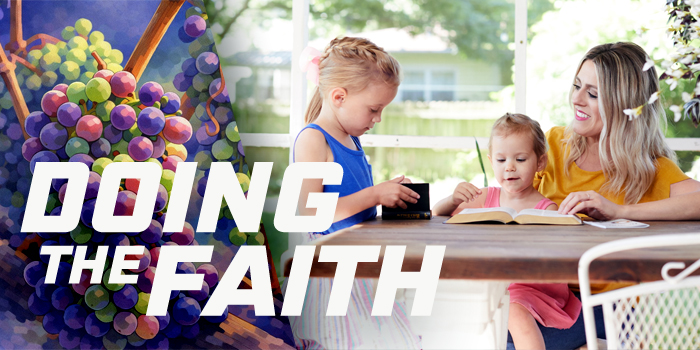
In this article, we turn to devotions. You have surely heard pastors and pastor-types speak about and exhort hearers to “do devotions,” but we rarely detail what that means or what it entails. Thus, the reason I’m writing this article! In the following paragraphs, I’m going to lay out a method for doing family/individual devotions.
Before I do, though, I want to address a few items as a preface. First, what are devotions? The word gives us a clue. You can hear the word devote in devotions. Devotions, then, would be about devoting ourselves to something. In this case, we’re devoting ourselves to Jesus by intentionally setting apart time to hear His Word and to reflect on it. At heart, then, doing devotions entails a regular ritual of reading, hearing, reflecting on, and considering God’s Word.
One of the keys to devotions is establishing them as an individual/family ritual. Rituals are regular and repeated actions to which we ascribe meaning and from which we derive benefit. For example, athletes often have pregame rituals (certain foods, music, warm-ups) that they regularly turn to or perform to help calm and focus themselves. Pastors will often kneel to pray (to calm their nerves and to ask God to work through them) before preaching a sermon. Employees will often enjoy a cup of coffee before work (or on their way to work) as a calming, preparatory ritual.
Rituals provide anchor points—safe and predictable harbors—in the often-chaotic oceans of our lives. To state the obvious: we need rituals. Individual/family devotions are important spiritual rituals that will anchor us in the faith and provide safe and predictable harbors for our souls.
Finally, as my last item of preface, I need to make clear that I will lay out a method for devotions. I am not writing about the way. The beautiful thing about devotions is that they can be customized. If you have a devotion ritual that is working for you/your family, fantastic! Take what is useful from what I’m going to share and ignore the rest. You don’t need to do exactly what I’m going to describe, but you do need the ritual of individual/family devotions.
Before I get into the meat of the article, I also want to acknowledge that some people enjoy devotional books. Portals of Prayer is a perennial favorite. Many have also appreciated the depth and breadth of Concordia Publishing House’s Treasury of Daily Prayer. You have also heard DCE Kathryn recommend excellent devotional resources in previous newsletters, and you have heard me recommend The Lent Project and The Advent Project from Biola University. For this article, however, I’m going to skip the devotional books/webpages and give you a method for reading Scripture successfully as an individual/family (as a complement to Word before World and The Regular Return, which I detailed in the previous article).
The heading here is important. What I’m going to share is intended to be scalable. In other words, you might not be able to do everything every day—and that’s okay. Life isn’t always predictable or regular, but you should strive to do something every day. This is about ritual, about establishing a safe harbor for your soul and a solid anchor point for your mind.
To start, pick a book of the Bible. You get to choose. If this is a new ritual for you, start with one of the Gospels, the Psalms, or Proverbs. These are great entry points. Then pick how much you want to read. It could be one chapter or even part of a chapter. If you are doing this as a family, you should read it out loud. You can designate who reads it. Dads, you should take a key leadership role in this. Even if you are doing this as an individual, consider reading it out loud. It will add another layer of hearing and another dimension of focus.
When you’ve finished reading, ask each member of the family to share their “one thing”—one thing that stood out to them, encouraged them, challenged them, or bewildered them. Talk about everyone’s one thing. You can decide how long the conversations will continue. Some days they may last only a couple of minutes. Some days they may last longer.
Don’t be afraid of not knowing what a particular text means. God gave you a pastor for that! Call, text, email, or stop in and ask your questions. If you are doing this as an individual, consider journaling your one thing or developing a regular ritual with a friend or family member centered on your one thing.
When you have finished your/everyone’s one thing, confess the Apostles’ Creed. Say it out loud. The Creed is a tremendous gift from the early generations of the church to later generations. Not only does it succinctly summarize the truths of Scripture, enabling us confidently to confess our faith in our Triune God, but it also provides the first line of defense against false teachings. If you are raising children, give this gift and protection to your children. If you live alone or do devotions by yourself, celebrate this gift and treasure this protection. Confess the Creed. Out loud.
After the Creed, give everyone the opportunity to share their high and their low from the day. What was the thing they enjoyed most about their day, and what was the thing they didn’t enjoy? What made them happy? What made them sad? What excited them? What frustrated them?
As with the “one thing,” if you are an individual, you may find great benefit in journaling your highs and lows and/or committing to this practice with a friend. If you are doing this as a family, this is a key part of your family devotions. This is the part that establishes a time and a place for sharing, listening, and supporting, which is critical for family unity and identity (and will pay dividends far into the future as children grow, marry, and begin families of their own). This will be a key piece in strengthening the family bond. It will allow parents and siblings opportunities to celebrate together and grieve together. It will pull individuals out of themselves and situate them within the family.
As with the “one thing,” you can decide how long this portion of your devotions continues. Some days you may have to have “lightning rounds,” placing limits on conversation for the sake of time. Some days you may have time to linger longer. You get to decide.
When you have finished sharing highs and lows, pray. You can decide how this will work best for you/your family. In our house, the “assistant of the day” (our system for eliminating children’s tendency to fight over whose turn it is) prays, and then I pray. These prayers can draw from the themes or teachings communicated in your Scripture reading and from your/your family’s highs and lows. Over time, your family will learn how to pray for each other and how to let Scripture inform your prayers.
If you’re interested in learning more about how to let Scripture guide your prayer, I recommend Rev. Dr. Matthew Harrison’s (President of our church body) translation of Martin Luther’s booklet on prayer entitled A Simple Way to Pray. I have copies available in my office. Here’s the simple summary: Read the text and ask these questions:
As you answer those questions, go to God in prayer. You can tell God what you’ve learned. You can thank Him for what He’s taught and/or given you. You can confess the sin He’s exposed. Then you can consider how the text might move you to lift someone else up in prayer.
When the prayers conclude, pray the Lord’s Prayer out loud. Even if you’re doing your devotions alone, pray the Lord’s Prayer—and consider doing it out loud. As with the Creed, saying it out loud focuses your mind and reduces distractions—and we need to have our minds focused! How often have you started praying silently and discovered several minutes later that your mind had wandered before you finished? Praying out loud doesn’t ensure that our minds won’t wander during prayer, but it does make focusing easier.
The more you pray the Lord’s Prayer (and reflect on it), the more you realize what a beautiful gift it is from our Lord Jesus, encompassing everything we need for body and soul. It’s worth praying out loud daily. Martin Luther, in his Large Catechism, extolled the Lord’s Prayer:
God takes the initiative and puts into our mouths the very words and approach we are to use. In this way, we see how deeply concerned He is about our needs, and we should never doubt that such prayer pleases Him and will assuredly be heard.… Thus there is no nobler prayer to be found on earth, for it has the powerful testimony that God loves to hear it. This we should not trade for all the riches in the world.[2]
After the Lord’s Prayer, bless your family. I’ll address the individual in a moment. Ideally, Dad will speak a concluding blessing, which can be something like this:
The grace of our Lord Jesus Christ, the love of God, and the communion of the Holy Spirit † be with us all. Amen.
Notice the symbol of the cross. This is an invitation to make the sign of the cross. I’ll say more about this in a moment, but for now, mark the invitation.
At this point, devotions are done, but there’s one more piece that remains until just before bedtime: the personal blessing. This can look different in different families, but the personal blessing is an opportunity for Dad and/or Mom to bless their children with God’s Word. Ideally, Dad will choose a verse from Scripture to speak over each child individually while making the sign of the cross on the child’s forehead.
This simple act has the power to profoundly impact children. Imagine your child(ren) hearing this personal blessing spoken over them thousands of times throughout their childhood. Do you think it will stay with them? Absolutely! They will surely forget many things about their childhood, but a personal blessing from Dad (or Mom), spoken over them thousands of times, is something they will remember for their entire life. Parents, bless your children.
Now we have the basic outline for devotions. Let’s discuss how to implement them. You can decide when in your day you will establish this individual/family ritual, but it needs to go somewhere. Like I said earlier, though, the beauty of scalable devotions is that you can scale them to your particular situation on any particular day. Some days are hectic and full. On those days, you may choose to do only highs and lows, blessings, and bed. Some days don’t end until late (getting home late from a ballgame or concert). On those days, you may simply do blessings and bed. But some days might allow for the full ritual: Bible, one thing, Creed, highs and lows, prayers/Lord’s Prayer, blessing, and bed.
Because these are scalable devotions, you are free to choose—without guilt!—what works for you. But no matter what, you will always, at the very least, do blessings and bed. This takes, at most, three minutes. Yet those minutes, multiplied by thousands of repetitions, pay huge dividends for children, even into adulthood. As I emphasized before, the point is not doing everything every day; the point is doing something every day. The point is the repetition of the ritual. It’s the repetition that matters, that gives the ritual its staying power.
Let’s return now to the individual. What should the individual do after the Lord’s Prayer? I recommend the following. In fact, I recommend this for everyone. Make the sign of the cross.
Despite what some have claimed, this is not a Roman Catholic practice. Yes, Roman Catholics make the sign of the cross, but the cross is not limited to any one confession. The cross belongs to everyone for whom Jesus died (which is everyone!). Make the sign of the cross and call the following to mind:
There is power in this simple action and in these simple confessions. By physically tracing the cross over your body, you are able to feel these promises. You can feel them on your forehead, in your stomach, and on your shoulders. These promises are for your body. Making the sign of the cross brings these promises into three dimensions so that you can feel them. By repeating them, this ritual reinforces your confession (lex orandi, lex credendi).
One of the reasons Christians have struggled to practice the faith is that we’ve largely reduced it to an idea that sits inactive in our heads. That needs to change. Our actions three-dimensionalize our confession. Our actions help us embody our confession. Our rituals bring our confession into our lived reality.
As I said before, what I’ve shared is a method to help you do this. Depending on what you’re already doing, you may incorporate all or none of what I’ve shared. The point isn’t following my suggestions; the point is establishing regular rituals to embody your confession. What I’ve shared is one way—one way that is doable and one way that works. Whether you adopt this way is up to you, but whatever you do, do the faith.
– Pastor Conner
Read Part 2: Reding Our Bibles
[1] We have referred to the church’s ancient dictum, lex orandi, lex credendi (the law of praying is the law of believing). The church’s practice of praying/worshiping (the things of the faith that we do), both reveals what we believe and shapes what we believe.
[2] The Large Catechism, Third Part: The Lord’s Prayer, 22-23.
Rev. Jonathan Conner is a contributor and speaker for Lutheran Family Service in the areas of mental health, godly living, and parenting. He is a regular guest on the podcast Issues, Etc., and the multi-part series Kids Have Questions. Pastor Conner is a graduate of Concordia Seminary St. Louis and currently serves as the pastor of Zion Lutheran Church in Manning, Iowa.
If you or someone you know would benefit from Christ-centered mental health counseling, refer to or contact us today.
Lutheran Family Service walks with those experiencing difficult times through mental health counseling, marriage counseling, crisis pregnancy counseling, and adoption services.
More posts about Godly Living